
CONFERENCE SITE
The joint event (XVII SIBGRAPI and II SIACG) will take place in the
Bourbon
Hotel, located in the heart of downtown Curitiba, Brazil between
17th-20th October, 2004.
Airport Transfer
International and domestic flights arrive at Afonso Pena International Airport located 20km from downtown. The transportation services from the airport are:
-
Minibus: A convenient bus service with air conditioning and TV set from the airport to the downtown. The ones who will take this line are able to ask the bus driver to stop in front of Bourbon Hotel. The ticket of this line costs R$ 5.00 (~1.70 US dollars) and can be purchased at the airport or with the bus driver. It is scheduled to leave on each 20 minutes.
-
Taxi: From the airport to downtown. It costs about R$ 35.00 (~12.00 US dollars). Taxi drives and bus personel at Curitiba only accept Brazilian currency in cash.
-
Bus: From the airport to downtown from each 25 min called "ligeirinho", a grey bus which costs around R$ 1.70 (~0.60 US dollars).
City of Curitiba
The capital of the State of Paraná, Curitiba, has become world renowned for its innovative urban solutions, winning a UNESCO prize for its urban development. Its integrated transport planning is responsible for an effective infrastructure that makes bus travel fast and convenient. Education and health are said to have been treated as priority services and the quality of life enjoyed by its inhabitants.
 The name
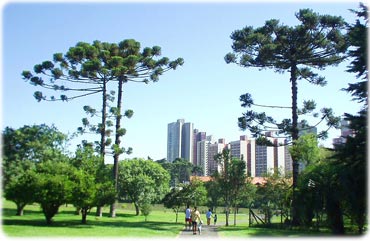
Curitiba comes from the endless pine forests that covered its territory. There are
two acceptable versions for the name's origin: the Indians of the Tupi nation, namely
the Jê and the Guarani - as well as the Tingüi - employed the word corae (pine seed)
atuba (a lot). The other version, also from the Tupi language, comes from the
combination of kurit (pine tree) and yba (large amount). Curitiba was founded in the
17th century as a gold-mining camp, became the capital of the State of Paraná in 1854
and grew rapidly after 1940. Its 1.6 million people are a synthesis of several
cultures of immigrants that arrived in the city during the 19th century and early
20th century. City of eclectic culture and of strong influence from the European
immigrants. This is mainly noticed in the city's architecture, gastronomy and
religion.
The name
Curitiba comes from the endless pine forests that covered its territory. There are
two acceptable versions for the name's origin: the Indians of the Tupi nation, namely
the Jê and the Guarani - as well as the Tingüi - employed the word corae (pine seed)
atuba (a lot). The other version, also from the Tupi language, comes from the
combination of kurit (pine tree) and yba (large amount). Curitiba was founded in the
17th century as a gold-mining camp, became the capital of the State of Paraná in 1854
and grew rapidly after 1940. Its 1.6 million people are a synthesis of several
cultures of immigrants that arrived in the city during the 19th century and early
20th century. City of eclectic culture and of strong influence from the European
immigrants. This is mainly noticed in the city's architecture, gastronomy and
religion.
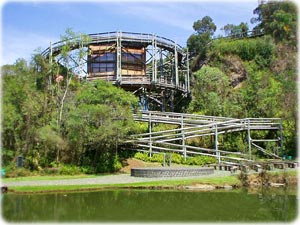 setting up Brazil's first environmental university, the Free University
of the Environment, which runs projects relating to a sustainable economy,
conservation of the ecosystem and environmental education. Deep in a native forest
covering 37,000 m2, its researchers are highly aware and are influencing the growth
of the city, which bases its economy on trade, the provision of services and
processing industries, scattered across Curitiba's Industrial City.
setting up Brazil's first environmental university, the Free University
of the Environment, which runs projects relating to a sustainable economy,
conservation of the ecosystem and environmental education. Deep in a native forest
covering 37,000 m2, its researchers are highly aware and are influencing the growth
of the city, which bases its economy on trade, the provision of services and
processing industries, scattered across Curitiba's Industrial City.
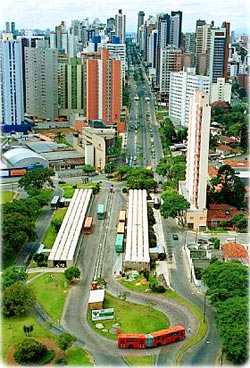
The transport system is a model for major cities. One of the most prosperous and organized cities in Brazil. This Brazilian metropolis, in southern Brazil, was nominated as the American Capital of Cultural 2003, an initiative of the Organization of the American States (OEA). The well-being of the citizen is the main preoccupation of the city, whose urban expansion is planned so as to avoid stress for its inhabitants. In order for both residents and visitors to enjoy the numerous parks and the city's pure air, the local corporation has organized a special bus service. Curitiba's buses carry 50 times more passengers than they did 20 years ago, but people spend only about 10 percent of their yearly income on transport. As a result, despite the second highest per capita car ownership rate in Brazil (one car for every three people), Curitiba's gasoline use per capita is 30 percent below that of eight comparable Brazilian cities. Other results include negligible emissions levels, little congestion, and an extremely pleasant living environment.
The city's trademark is the pine-kernel footprint walk. This is a three kilometer route that can be walked, cycled or travelled along by a special bus running between the city's tourist spots. By following the enormous pine-kernels painted on the ground, the visitor can follow a cultural and historical route that forms part of the Footprints in the Memory project leading to churches, historic buildings and squares. A pine-kernel (pinhão) image was used to create the icons of the SIBGRAPI'2004 web page (see the logo).
 The Curitiba Minor
Basilica Cathedral is situated in Tiradentes Square where the city of Curitiba was
born, it was inaugurated in 1893, built in the neo-Gothic style and inspired by
Barcelona Cathedral. The original image, dedicated to Our Lady of Light, came from
Portugal in 1720 and is now in the Paraná Museum. The Relógio das Flores (Clock of
Flowers) is situated in Garibaldi Square, it measures six meters in diameter and
consists of different flowers planted according to the season. The Rua das
Flores (Flower Street) is the first pedestrian street in Brazil, inaugurated in 1972,
with well-tended pots of flowers and bars and confectioners in hundred-year-old
buildings and lanchonetes.
The Curitiba Minor
Basilica Cathedral is situated in Tiradentes Square where the city of Curitiba was
born, it was inaugurated in 1893, built in the neo-Gothic style and inspired by
Barcelona Cathedral. The original image, dedicated to Our Lady of Light, came from
Portugal in 1720 and is now in the Paraná Museum. The Relógio das Flores (Clock of
Flowers) is situated in Garibaldi Square, it measures six meters in diameter and
consists of different flowers planted according to the season. The Rua das
Flores (Flower Street) is the first pedestrian street in Brazil, inaugurated in 1972,
with well-tended pots of flowers and bars and confectioners in hundred-year-old
buildings and lanchonetes.
Between the plains and the coast, one of the state's most alluring routes is the one followed by the Imperial Railway which since 1880, has linked Curitiba with Paranaguá. The precipices of the Serra do Mar in the middle of the Atlantic Forest are skirted by 100 kilometers of track, passing through tunnels, over bridges, viaducts and ravines washed by waterfalls. For those who prefer to go by road, the same section can be travelled by the Graciosa highway which still has stretches that have the original 1873 surface, adorned by kilometers of giant hydrangeas and where, during a pause to enjoy the view, the visitor can enjoy the state's most typical dish, barreado. A legacy of the Brazilian Indians, this delicacy is prepared with salted beef, bacon and spices which must be cooked together for ten hours in a clay pot with a crust of moistened cassava flour. The resulting shredded meat is accompanied by a succulent porridge and baked banana.
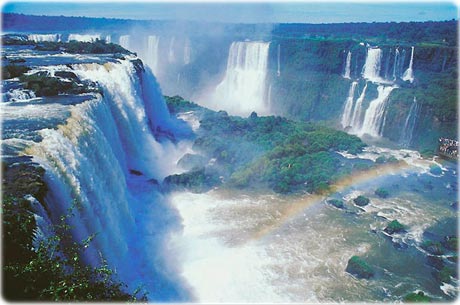 Located in Paraná is the Brazilian portion of the Itaipu hydroelectric plant, on
the River Paraná. Together with other plants such as those at Foz da Areia, Salto
Santiago, Salto Segredo and Salto Osório on the River Iguaçu, the State produces 25%
of Brazil's electricity. It takes advantage of the dams to attract tourists such as
in the case of Itaipu Lake, an area bounded by around 1,300 km of shoreline, part of
which faces the Iguaçu Falls in
The Iguaçu National
Park that covers an area of 220,000 hectares - 170,000 in Brazil and 50,000 in
Argentina - declared as being a World Heritage Site by
UNESCO.
Located in Paraná is the Brazilian portion of the Itaipu hydroelectric plant, on
the River Paraná. Together with other plants such as those at Foz da Areia, Salto
Santiago, Salto Segredo and Salto Osório on the River Iguaçu, the State produces 25%
of Brazil's electricity. It takes advantage of the dams to attract tourists such as
in the case of Itaipu Lake, an area bounded by around 1,300 km of shoreline, part of
which faces the Iguaçu Falls in
The Iguaçu National
Park that covers an area of 220,000 hectares - 170,000 in Brazil and 50,000 in
Argentina - declared as being a World Heritage Site by
UNESCO.
Travel and Tourism
Information
Secretariat for Lodgment and Travel:
RD Eventos Ltda.
Avenida Silva Jardim, 2705
80240-020 Curitiba/PR Brazil
Phone: +55 41 343-3904
Fax: +55 41 343-8094
http://www.eventosrd.com.br
e-mail: rd@eventosrd.com.br
Interesting links about Curitiba
http://www.curitiba.pr.gov.br
http://tudoparana.globo.com/afterhour